Anna Fusoni: Driving Emerging Talent in Mexico
By Valentina Suárez | 2026 | Brand Strategist & Sustainability Mentor

Anna Fusoni has sustained the fashion industry from within for over four decades, betting on talent that didn't yet have a clear place in it, long before she began narrating it.
I sat down with Anna on a Tuesday morning in April. She was in Mexico City, and I was in the mountains of Colombia. Through a screen, I began to discover that her story is told not just through her achievements, but through her memory, her judgment, and her stubborn faith in talent that is just beginning.
From the very first moment, I understood that her story cannot be told solely by her accomplishments. There is something deeper in the way she speaks about fashion: memory, judgment, frankness, and an almost stubborn faith in talent that is just starting out.
"I want people to remember me as someone who always believed in the youth, in talent... in all talents."
The Origin of a Unique Perspective
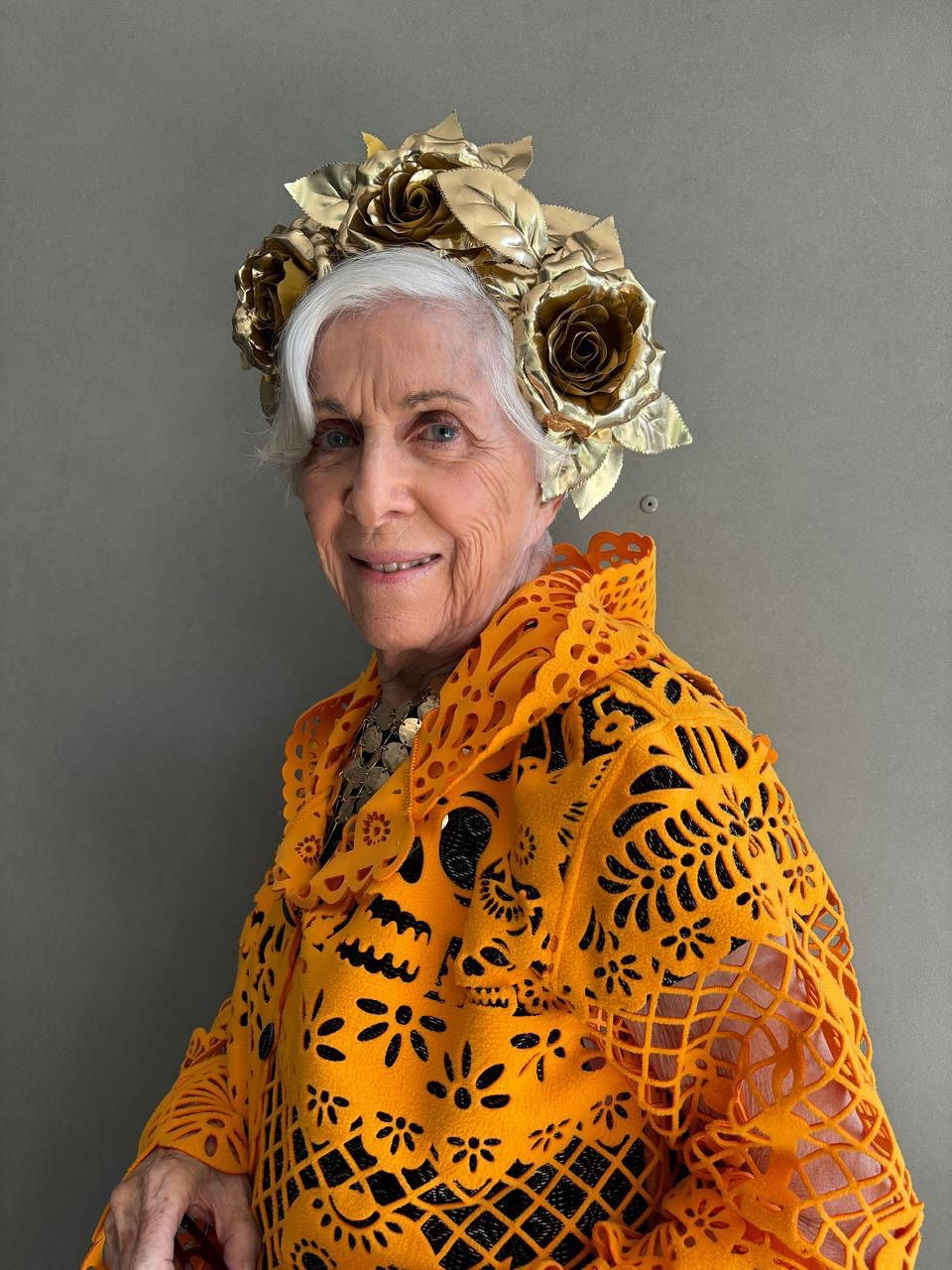
The story of Anna Fusoni does not begin with fashion, but with a particular way of looking at the world. Born in London in 1944 in the midst of the post-war era, she was shaped by scarcity, rationing, and a mindset of austerity that defines her relationship with consumption and life to this day.
"We had a mindset of frugality... that doesn't go with fashion, but it has allowed me to be equanimous and keep moving forward," she notes. This distance from consumption allowed her to observe fashion without being dazzled solely by the surface. She was also influenced by her father, a journalist, from whom she inherited a critical eye and a way of taking nothing for granted.
Her arrival in fashion was a fortunate accident. At 22, while studying in the United States, she participated in a Vogue journalism contest, became a finalist, traveled to New York, and won the prize: working at the magazine for a year. "I didn't even know the word 'fashion,'" she admits.
After that experience, Anna returned to Mexico and arrived almost by accident at El Palacio de Hierro, entering an ecosystem where fashion already existed but was still far from consolidating as an industry. "People went to see what was there," she says. That phrase serves as a snapshot of the era. Since then, the industry has grown rapidly, but as Anna makes clear, not all growth implies structure.

An Uncomfortable Voice in an Industry Under Construction
Throughout her career, Anna Fusoni has built a reputation that is both uncomfortable and profoundly necessary. She says it herself with irony: "I am very reckless, and I don't care."
But that recklessness is not carelessness. It is her way of maintaining honesty within an industry that often avoids confrontation. "If someone asks me something, I answer them." That clarity has cost her spaces and relationships, but it has also given her something harder to build: credibility.
From that vantage point, she has watched Mexican fashion grow, pushing it forward through fairs, salons, exhibitions, and her own platforms. Today, she recognizes that fashion in Mexico is finally seen as an industry. "20 or 25 years ago, fashion was not a priority... today it is."
However, she also knows that growth is not enough if it is not accompanied by structure. "I do believe there is a lack of curation... and a lack of curators." For Anna, fashion has never been just expression; it is also judgment, business, sustainability, and industry. "A designer isolated in their creative tower will be very happy... but it's not very useful."
Moda Premio: A Living Legacy
If there is one project that synthesizes her vision, it is Moda Premio. She repeats it several times during the interview, and a change in her attitude is noticeable. With pride and passion, she tells me she sees it as a platform.
"Do you know what it's like to last since 1986... through highs and lows... and keep going? I believe it is the constancy that makes me most proud." That conviction has sustained a project that has survived crises, government changes, industry transformations, and even earthquakes. "I decided it was time for payback."
Through this competition, Anna has built a network of designers who found their first push there, just as she found hers when she won the Vogue contest. Notably, Anna does not only believe in young talent; she believes in emerging talent—the kind that does not discriminate by age, context, or background. "Creativity is evaluated. Not whether you are 18 or 45 years old."
The Woman Who Remains

Anna distances herself from the stereotypical image of a woman in fashion. She is not a consumerist, and she certainly does not follow trends. "This is all I have... and it's all I need."
Her relationship with fashion is a life project, even when she wonders why she continues working in it instead of "going to harvest corn or daisies." In her private life, Félix Sánchez appears—her husband and "best PR"—as a loving counterweight to her character. "As blunt as I can be, Félix is the man everyone loves." She speaks of him with a smile and a love that crosses the screen. In that moment, another side of Anna appears: softer, more everyday, and just as essential.
In an industry obsessed with novelty, her permanence is a form of resistance. Anna says it with humor: "I'm not the most relevant... I'm the most long-lived." But in that longevity, there is memory, context, and a history. She has seen the industry transform, seen names, platforms, and discourses emerge and disappear, and yet she remains present. Anna Fusoni is not just what she has done, but her decision to keep doing it.
by Valentina Suárez | 2026 | Brand Strategist & Sustainability Mentor


Comments