Starlin de Holma: The Force of the Street Elevated to High Fashion
From Manoguayabo to international stages, the Dominican designer has built a career where urban fashion, haute couture, music, and an unexpected career in medicine coexist.
To talk about Starlin de Holma is to talk about versatility. Designer, model, runway director, mentor to new talent, and radiologist, the Dominican creative has built a career that is difficult to categorize. His story unfolds between two worlds that, at first glance, might seem completely opposite: the precision of medicine and the freedom of fashion.
That duality is not a contradiction, but the essence of his identity. The same principle appears in each of his facets: observing carefully, understanding anatomy, caring about details, and transforming whatever is in front of him.
His story began in Manoguayabo, a community in Santo Domingo Oeste that remains a fundamental reference point in his creative language. It was there that he discovered the force of the street, the authenticity of Dominican culture, and the power of image to tell a story.
Before designing his own collections, Starlin got to know fashion from the other side of the runway. He began working as a model in national shows and as the face of different brands. The experience allowed him to understand not only how a garment should look, but how it should feel and move on the body.
“My roots in Manoguayabo gave me the authenticity and style of the street. International experiences added polish and sophistication to my work,” he explains.
Between Medicine and Design
While he was beginning to make his way in fashion, Starlin was studying Medicine at the Universidad Autónoma de Santo Domingo. After four years of study, he made the difficult decision to pause his studies to devote more attention to design and pursue the opportunities that were beginning to appear.
It wasn’t an easy choice. It meant temporarily stepping away from an established professional path to enter an uncertain and competitive industry. However, his calling for fashion proved impossible to ignore.
That shift in direction did not mean permanently abandoning medicine. Starlin managed to keep both dimensions of his life present and currently also works as a radiologist. The experience taught him that a person doesn’t necessarily have to be reduced to a single profession, or give up part of themselves to develop another.
That personal story also explains his constant interest in transformation. Starlin doesn’t conceive of design through a rigid formula. His work moves between streetwear, costumes for artists, gala proposals, bridal collections, and children’s clothing.
“I want to show that a designer can work with streetwear and also create a groom’s suit or a gala gown. A category shouldn’t limit what we’re capable of doing,” he states.
When Urban Wasn’t Yet the Protagonist
One of the moments that defined his career came when he decided to focus on urban clothing design. Observing the Dominican market, he found a creative space that wasn’t yet sufficiently recognized.
At that time, urban music was beginning to transform the country’s popular culture, but its artists had not yet earned the place they would later win within the international industry. Nor was there a fully developed fashion structure to accompany the visual construction of their careers.
Starlin identified that gap as an opportunity. Working around figures like Mozart La Para, Kiko el Crazy, and El Alfa allowed him to connect with a generation of artists who needed an image as powerful as their music.
The street became his main creative laboratory. From it he drew the energy, spontaneity, and freedom needed to challenge traditional dress codes. However, his goal was never to literally reproduce urban codes, but to transform them through structured cuts, quality textiles, and precise finishes.
His intention was clear: to show that streetwear could be sophisticated and occupy the same spaces as proposals traditionally linked to luxury.
For the designer, elegance doesn’t depend on a specific silhouette, nor does it belong exclusively to classic codes. It can also be found in a youthful garment, in an unexpected volume, or in the confidence with which someone wears a look.
“Elegance doesn’t have a single mold. Freshness, boldness, and contemporary trends also belong to luxury and high fashion,” he maintains.
The Project That Opened International Doors
Another turning point came when Starlin took part in creating the wardrobe for the music video for “Panties y Brasieres,” performed by Rauw Alejandro and Daddy Yankee.
The project’s international scope represented a new platform for his work. From that experience on, opportunities began opening up with directors, artists, and production companies outside the Dominican Republic.
His participation as a representative of Dominican fashion in Venice, Italy, and his presence at Dominican Republic Fashion Week broadened his perspective even further. Those settings allowed him to observe other ways of producing, presenting, and communicating a collection.
One of the biggest challenges of that period was traveling to Europe with less than a month of preparation. The speed of the process tested his organizational skills and his willingness to take risks.
The experience reinforced one of the most important lessons of his career: great opportunities don’t always come at the perfect moment. Sometimes they demand acting quickly and trusting that years of preparation will be enough to meet the challenge.
Designing a Complete Experience
Having worked as a model, designer, and runway director transformed the way he understands a collection. Starlin doesn’t imagine garments as isolated objects. He thinks about the body that will wear them, the movement on the runway, the music, the lighting, and the emotion he wants to evoke.
Art direction, stage design, and the music industry have a decisive influence on his creative process. Before finishing a piece, he needs to imagine the complete universe it will exist within.
This comprehensive outlook also taught him to recognize the work of everyone involved in a production. For him, a runway show isn’t built solely from the designer’s vision. It’s the result of collaboration between models, seamstresses, stylists, makeup artists, producers, assistants, and everyone who works behind the scenes.
“Every person who takes part in the industry deserves respect and recognition, no matter what position they hold,” he affirms. “A show depends on the effort of an entire team.”
Discipline, respect, and attention to detail have become essential principles of his brand.
Versatility as a Creative Statement
With more than twelve collections presented, Starlin de Holma has made versatility one of the pillars of his work. His most recent proposal reaffirms precisely that ability to move between different languages without losing his identity.
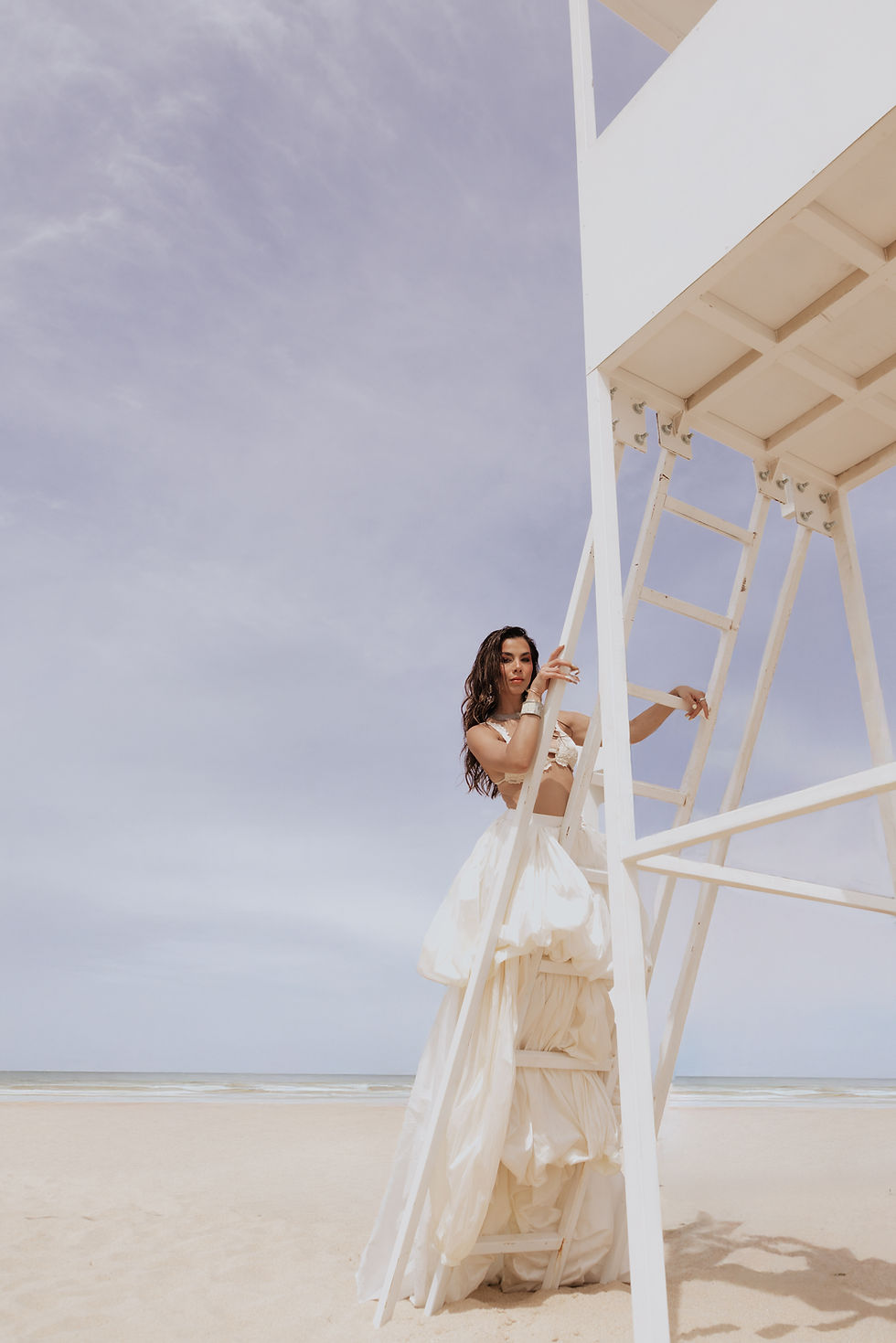
The collection explores the contrast between formal structure and the ease of urban fashion. It features textiles with body, combinations of textures, youthful cuts, and finishes inspired by haute couture.
The silhouettes were conceived to accompany the anatomy and take on a new dimension through movement. More than dressing the body, they aim to change posture and convey a feeling of confidence.
The result reflects the person he designs for: someone bold, creative, and aware of their presence. Artists and individuals who aren’t afraid to be seen and use fashion as an extension of their personality.
Starlin wants people, when wearing one of his pieces, to experience confidence, power, and sophistication. For him, a garment shouldn’t become a costume, but a tool to amplify the identity of whoever wears it.
“What I value most is when someone tells me that wearing one of my designs makes them feel empowered, authentic, and impossible to overlook,” he shares.
Designing from the Dominican Republic
Although his ambitions are international, Dominican identity remains at the center of his project. Starlin believes that his place of origin isn’t a limitation, but a source of differentiation.
Manoguayabo gave him a sensibility that would be hard to learn in a classroom: the ability to observe the street, understand its codes, and recognize the creativity born outside traditional circuits.
His participation in international events added new tools to that knowledge, but it didn’t replace his roots. Instead of abandoning his community’s language to move closer to luxury, he decided to carry it with him and show that both worlds could coexist.
This vision is also present in his commitment to local production. Within his workshop, he strives to make the most of materials and create timeless, resistant, and long-lasting pieces.
For Starlin, sustainability isn’t just about following a global conversation. It begins with respect for materials, the craft of garment-making, and the time of the people involved in each piece.
Opening the Way for a New Generation
His creative project extends beyond his own label. As part of his plans, he seeks to build up the training of new talent through his modeling agency, Black and White.
The initiative reflects his interest in sharing the experience he has gained as a model, director, and designer, but also in creating opportunities for young people who don’t always have access to the industry.
Starlin sees fashion as a tool for inclusion and social mobility. His own career shows that talent can emerge in any community and reach global stages when it finds preparation, discipline, and opportunity.
“Fashion can carry the cultural richness of places like Manoguayabo out into the whole world. Through art and hard work, we can break down barriers and change how our communities are perceived,” he notes.
His outlook for the future includes expanding his label internationally and strengthening the presence of Dominican fashion in cities like New York, Paris, Milan, and London. However, his ambition isn’t limited to personally occupying those spaces. He also wants his journey to help open doors for other Caribbean designers.
A Fashion House Without Borders
In five years, Starlin de Holma envisions his project turned into an internationally recognized fashion house, with a presence at major events and an identity capable of transcending categories and borders.
Avant-garde, timeless, disruptive, urban, and versatile are the five words he uses to define his brand. All of them also describe the way he has built his professional life.
From medicine to the runway, his career challenges the idea that a person must choose a single identity. Starlin has learned to inhabit different spaces and to use each experience to enrich the next.
His approach isn’t about leaving the street behind to enter the world of luxury. It’s about showing that the street can also be luxury, that urban fashion can coexist with high-level craftsmanship, and that stories born in the Caribbean deserve a place in the international conversation.
In that combination of precision and freedom, Manoguayabo remains present. Not as a reference to the past, but as the root from which Starlin de Holma continues to imagine his future.

Comments